
Why Density Testing Is Powerful for Gold Retailers | Omio
Why Density Testing Is Powerful for Gold Retailers: Testing Jewellery Without Melting
For gold retailers, buying old or second-hand jewellery comes with an important challenge: how can you evaluate the jewellery before buying it without melting or damaging it?
A jewellery piece may look like genuine gold, carry a hallmark, and have the appearance of high-purity gold. But appearance alone does not tell the complete story. Gold-plated jewellery, mixed-metal construction, soldered sections, and other materials can create a risk for retailers who purchase jewellery directly from customers.
This is where density and specific-gravity testing can become a powerful part of a professional gold-buying process.
A density-based gold testing machine evaluates the relationship between the mass and volume of the complete jewellery article. This gives retailers another important measurement before deciding how to value and purchase the item.
Why Gold Retailers Need Reliable Testing Before Buying
Retailers who purchase old gold or second-hand jewellery are making a financial decision every time they buy an item.
If the purity or construction of the jewellery is different from what is claimed, the retailer may pay more than the actual value of the recoverable gold.
Professional gold buyers should not depend only on:
- Visual appearance
- Colour
- Hallmarks
- Customer claims
- Surface inspection
These checks can be useful, but they do not provide the complete picture in every situation. A reliable testing process can give the retailer additional information before money is committed to the purchase.
What Is Density Testing for Gold?
Density is the relationship between an object's mass and its volume.
Gold is a high-density material. When the composition of a jewellery article changes, its overall density can also change.
Density-based gold testing uses measurements of the jewellery's weight and volume-related properties to determine its density or specific gravity.
The measured result can then be compared with the expected characteristics of the material and claimed purity.
In simple terms, the retailer is not asking only: "What does this jewellery look like?"
The retailer is also asking: "Does the physical density of this complete article make sense for the material and purity being claimed?"
Why Density Testing Is Different From Looking at the Surface
Imagine two jewellery pieces that look almost identical.
Jewellery A: Predominantly Gold
The jewellery is made predominantly from gold of the expected purity. Its overall physical characteristics should be consistent with that material, within the limitations of the testing method.
Jewellery B: Gold-Coloured or Gold-Plated Exterior
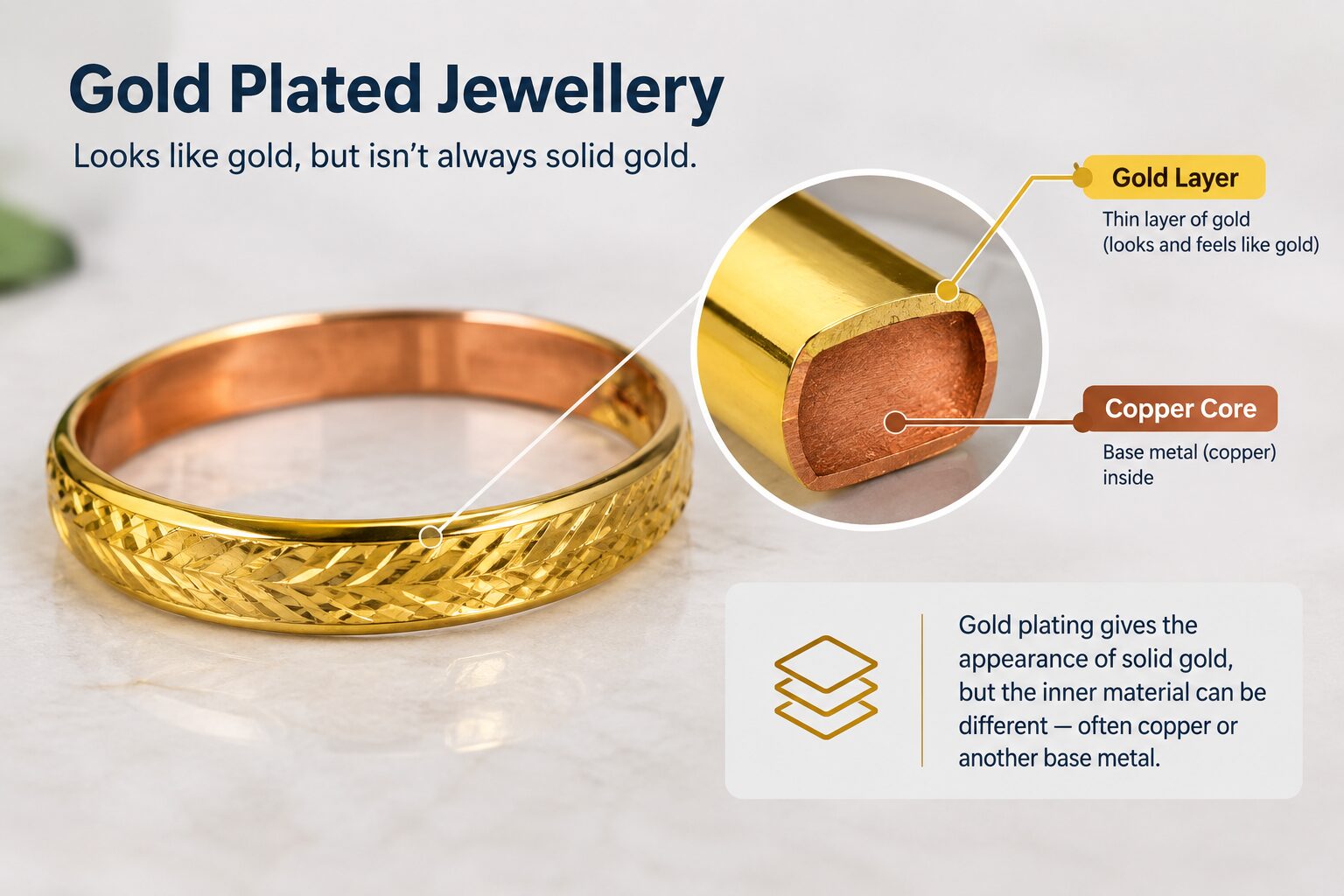
The jewellery has a gold-rich exterior but contains another material underneath.
Visually, both pieces may look similar. However, their overall mass-to-volume relationship can be different if the underlying material makes up a meaningful portion of the article.
This is one of the reasons density testing can be valuable as a non-destructive screening method.
Gold-Plated Jewellery: Why Retailers Should Be Aware
Gold plating is an important consideration for businesses that buy used jewellery.
In plated jewellery, a layer of gold is applied over another material. The outside can therefore appear similar to genuine gold even though the underlying material is different.
For a retailer, the important question is not simply:
"Does the jewellery look like gold?"
A more useful question is:
"Are the physical characteristics of the complete article consistent with the claimed material and purity?"
Density testing can provide useful information when answering that question.
If the non-gold material significantly changes the overall density of the article, the measured result may be inconsistent with what would normally be expected.
This gives the retailer a reason to investigate the item further before completing the purchase.
Can Density Testing Detect Gold-Plated Jewellery?
Density testing can help identify inconsistencies caused by different materials, but it should not be described as a universal detector for every plated jewellery item.
The effect of plating on the overall density depends on the thickness of the gold layer, the material underneath, and how much of the complete article is made from each material.
A very thin gold-plating layer may have only a small effect on the overall density.
Therefore, density testing is best understood as a powerful screening and verification tool that can provide another layer of information before a retailer makes a purchasing decision.
Why Density Testing Is Powerful for Retailers Buying Without Melting
When buying jewellery from customers, retailers often want to preserve the article in its original condition until they are confident about the purchase.
Melting the jewellery immediately may not be practical because:
- The customer may want the jewellery returned
- The retailer may still be negotiating the purchase
- The article may have stones or decorative elements
- The retailer may want to inspect the jewellery before committing to a purchase
- The jewellery may have resale value in its original form
A non-destructive testing method can therefore be extremely useful.
With density testing, the retailer can obtain an additional measurement without first melting the jewellery.
Density Testing vs XRF: Why the Difference Matters
Retailers often ask why they should consider density testing when XRF is already available for gold analysis.
The reason is that the two technologies approach the testing problem differently.
What Is XRF?
XRF stands for X-ray fluorescence.
XRF instruments are widely used for elemental analysis. They can identify and estimate the concentration of elements detected from the area being measured.
This makes XRF highly useful for analysing the elemental composition of jewellery at the measurement area.
However, an XRF measurement is influenced by the material near the surface, measurement location, instrument geometry, and other testing conditions.
Therefore, a surface XRF measurement should not automatically be interpreted as a complete analysis of every part of a complex jewellery article.
What Is Different About Density Testing?
Density testing takes a different approach.
Instead of primarily asking what elements are detected at a particular surface location, density testing evaluates the relationship between the mass and volume of the complete article.
This provides a different type of information that can be particularly useful when a retailer is buying jewellery without melting it.
In Simple Terms
XRF: What elemental composition is detected at the area being measured?
Density testing: Does the overall physical density of the article correspond reasonably with the expected material?
Because they answer different questions, density testing and XRF can be complementary technologies rather than direct replacements for one another.
Why Surface Testing Alone May Not Tell the Whole Story
Consider a jewellery article with a gold-rich surface and a different material underneath.
If only a small surface area is analysed, the result primarily describes what is being measured at that location.
Density testing approaches the article from another direction by evaluating its overall mass-to-volume relationship.
This difference can be valuable for retailers because a purchasing decision involves the complete jewellery article, not just one small measurement area.
A Practical Gold-Buying Workflow for Retailers
Density testing can be incorporated into a simple professional workflow.
- Inspect the jewellery. Look at the hallmark, colour, construction, wear, soldered areas, stones, and possible signs of plating. ```
- Weigh the jewellery. Record its mass accurately.
- Perform density testing. Measure the physical characteristics of the complete article.
- Evaluate the result. Compare the measurement with the expected characteristics of the claimed material and purity.
- Investigate unusual results. If the result is inconsistent or the jewellery is complex, perform additional inspection or another suitable analytical test. ```
This process gives the retailer more information before deciding whether and how much to pay for the jewellery.
Real-World Example: Buying a Customer's Gold Bracelet
Imagine a customer brings a bracelet to a jewellery retailer and says that it is 22K gold.
The bracelet looks genuine and carries a purity marking.
Instead of relying only on appearance, the retailer can follow a structured testing process.
First: Inspect
Check the hallmark, construction, colour, visible wear, soldered areas, stones, and any suspicious sections.
Second: Weigh
Measure the jewellery accurately.
Third: Perform Density Testing
Use a suitable density-based gold testing machine to measure the article's density or specific gravity.
Fourth: Evaluate
Compare the result with what would reasonably be expected from the claimed material and purity.
Fifth: Investigate If Necessary
If something does not look right, the retailer can perform additional checks before completing the purchase.
The key advantage is that the retailer has gathered additional information without first melting the bracelet.
Why This Can Reduce Risk for Gold Buyers
A retailer purchasing gold is managing financial risk with every transaction.
Even a small difference between the claimed and actual material can become financially significant when buying high-value jewellery.
Density testing can therefore be useful as part of a broader purchasing process because it gives the retailer another measurement to consider before committing money.
It can help retailers:
- Screen incoming jewellery
- Investigate suspicious articles
- Evaluate jewellery without melting it first
- Identify physical inconsistencies
- Reduce reliance on visual appearance alone
- Make more informed buying decisions
Why Density Testing Works Well as a First-Line Screening Method
Not every jewellery article requires exactly the same testing process.
For many routine buying situations, a retailer can use a simple workflow:
Inspect → Weigh → Density Test → Evaluate → Investigate if Necessary
If the result is consistent with expectations, the retailer has another useful piece of evidence.
If the result is unusual, the retailer knows that the article deserves further investigation before a final purchase decision.
Why Density Testing Should Be Part of a Professional Testing Strategy
Density testing should not be viewed as a replacement for every other gold testing technology.
Different testing methods provide different types of information.
A professional retailer can use visual inspection, density testing, XRF, and other suitable methods depending on the type and condition of the jewellery.
The important point is to understand what each method can and cannot tell you.
Important limitation: Hollow jewellery, cavities, stones, mixed materials, and certain complex constructions can affect density measurements and may require additional inspection or another suitable testing method.
Omio Gold Testing Machine for Retailers
Omio Technologies provides density-based gold testing machines designed for businesses that need a practical way to evaluate gold and jewellery using density and specific-gravity measurement.
The Omio Gold Testing Machine is particularly relevant for retailers and gold buyers who want to test jewellery without immediately melting it.
By measuring the relationship between the jewellery's mass and volume, the machine provides an additional physical measurement that can be considered alongside visual inspection and other testing methods.
Omio Technologies offers models including the Omio Gold Testing SES423 and Omio Gold Testing SES623.
Businesses can choose a suitable model based on their testing requirements, jewellery types, testing volume, capacity needs, and workflow.
Why Retailers Should Test Before They Buy
When a retailer buys old gold, the testing process is not simply about finding a purity number.
It is about reducing uncertainty before money changes hands.
A professional testing process can help answer important questions:
- Does the jewellery's physical behaviour match the claimed material?
- Are there signs that require further investigation?
- Can the jewellery be evaluated without melting it first?
- Is additional testing necessary before purchase?
The more information a retailer has before purchasing, the better equipped they are to make an informed decision.
Final Takeaway
Density testing is powerful for gold retailers because it provides a different perspective from simply examining the surface of jewellery.
By evaluating the relationship between the mass and volume of the complete article, density testing can provide useful information about whether the physical characteristics of jewellery are reasonably consistent with the claimed material and purity.
This can be especially valuable for retailers who buy old or second-hand jewellery and want to evaluate it without melting or damaging it before making a purchasing decision.
Density testing is not a magic solution for every type of jewellery, and unusual or complex articles may require additional testing. But when used correctly as part of a professional testing workflow, it can provide retailers with another important layer of information and help reduce purchasing risk.
With an Omio Gold Testing Machine, retailers can bring density-based testing into their gold-buying workflow and evaluate jewellery before deciding how to proceed.
Don't judge valuable jewellery only by what you can see on the surface. Measure the complete article before you buy.