
XRF vs Density Meter for Gold Testing: Which Method Is Better for Jewellery Testing?
XRF vs Density Meter for Gold Testing: Which Method Is Better for Jewellery Testing?
When it comes to checking gold purity, jewellers and gold buyers commonly use two technologies: XRF (X-Ray Fluorescence) and Density Meter testing.
Both methods have their own advantages, but they work in completely different ways. For many jewellery applications, a density meter offers a simple, non-destructive and cost-effective method for checking gold purity.
What Is a Gold Density Meter?
A gold density meter works on the Archimedes principle. It determines the density (specific gravity) of a gold item by measuring its weight in air and its apparent weight when immersed in a liquid.
Because different gold alloys have different densities, the measured specific gravity can help indicate the approximate purity of the item.
What Is XRF Gold Testing?
XRF, or X-Ray Fluorescence, uses X-rays to analyse the elemental composition of a material. It can identify elements such as gold, silver, copper, zinc and other metals present in the tested area.
XRF is widely used when detailed elemental analysis is required.
However, XRF primarily analyses the surface or near-surface area of the jewellery. This is an important consideration when testing plated, coated or surface-treated jewellery.
XRF vs Density Meter for Gold Testing
| Feature | XRF Gold Tester | Density Meter |
|---|---|---|
| Testing principle | X-Ray Fluorescence | Archimedes Principle |
| Radiation | Uses X-rays | No radiation |
| Testing method | Surface/near-surface elemental analysis | Overall density measurement |
| Sample damage | Generally non-destructive | Non-destructive |
| Testing speed | Fast | Fast |
| Operating method | Instrument-based elemental analysis | Simple weight & immersion measurement |
| Maintenance | Generally higher | Low |
| Cost | Generally higher | More affordable |
| Portability | Depends on model | Many compact models available |
| Jewellery testing | Excellent for elemental analysis | Excellent for suitable solid jewellery |
| Coated/plated items | Surface composition can influence results | Density can help identify inconsistencies |
| Radiation safety requirements | Applicable | No radiation-related concerns |
Why Choose a Density Meter for Jewellery Testing?
1. No Radiation
One of the biggest advantages of density-based testing is that it does not use X-rays or radioactive sources.
This makes density testing a practical choice for jewellers who want a straightforward testing method without radiation-related considerations.
2. Non-Destructive Testing
A density meter can test suitable jewellery without cutting, drilling or chemically damaging the item.
This is particularly useful when dealing with valuable jewellery that customers do not want to damage.
3. Affordable Gold Testing Solution
Compared with many professional XRF systems, density meters can provide a more economical solution for routine gold testing.
For small and medium-sized jewellery businesses, this can make density testing an attractive option.
4. Simple Testing Principle
Density testing is based on a well-established scientific principle:
Density = Mass ÷ Volume
The machine determines the object's density using measurements in air and liquid and compares the result with expected specific-gravity values.
5. Useful for Overall Density Assessment
Density testing evaluates the overall physical density of the tested object. This can be useful when checking suitable solid gold jewellery where the item's structure and composition are consistent throughout.
6. No Need to Damage Valuable Jewellery
For jewellers, gold buyers and jewellery businesses, protecting the customer's jewellery is extremely important.
A non-destructive density test allows suitable pieces to be checked while keeping the jewellery intact.
Does Density Testing Replace XRF?
Not always.
XRF and density testing are different technologies and can be useful for different purposes.
XRF is valuable when you need elemental composition analysis, while density testing is a practical option for checking the specific gravity and density of suitable gold items.
For professional jewellery businesses, the best choice depends on:
- Type of jewellery being tested
- Required accuracy
- Budget
- Testing volume
- Whether elemental analysis is required
- Whether the jewellery contains stones, hollow sections or coatings
In some businesses, the two technologies can even be used as complementary testing methods.
When Is a Density Meter Suitable?
A density meter is particularly useful for testing solid, plain jewellery, gold coins and suitable gold samples.
However, density testing has limitations.
Items that are hollow, heavily stone-studded or contain significant non-metallic components may not be suitable for accurate density-based testing because their measured density can be affected by their internal structure or other materials.
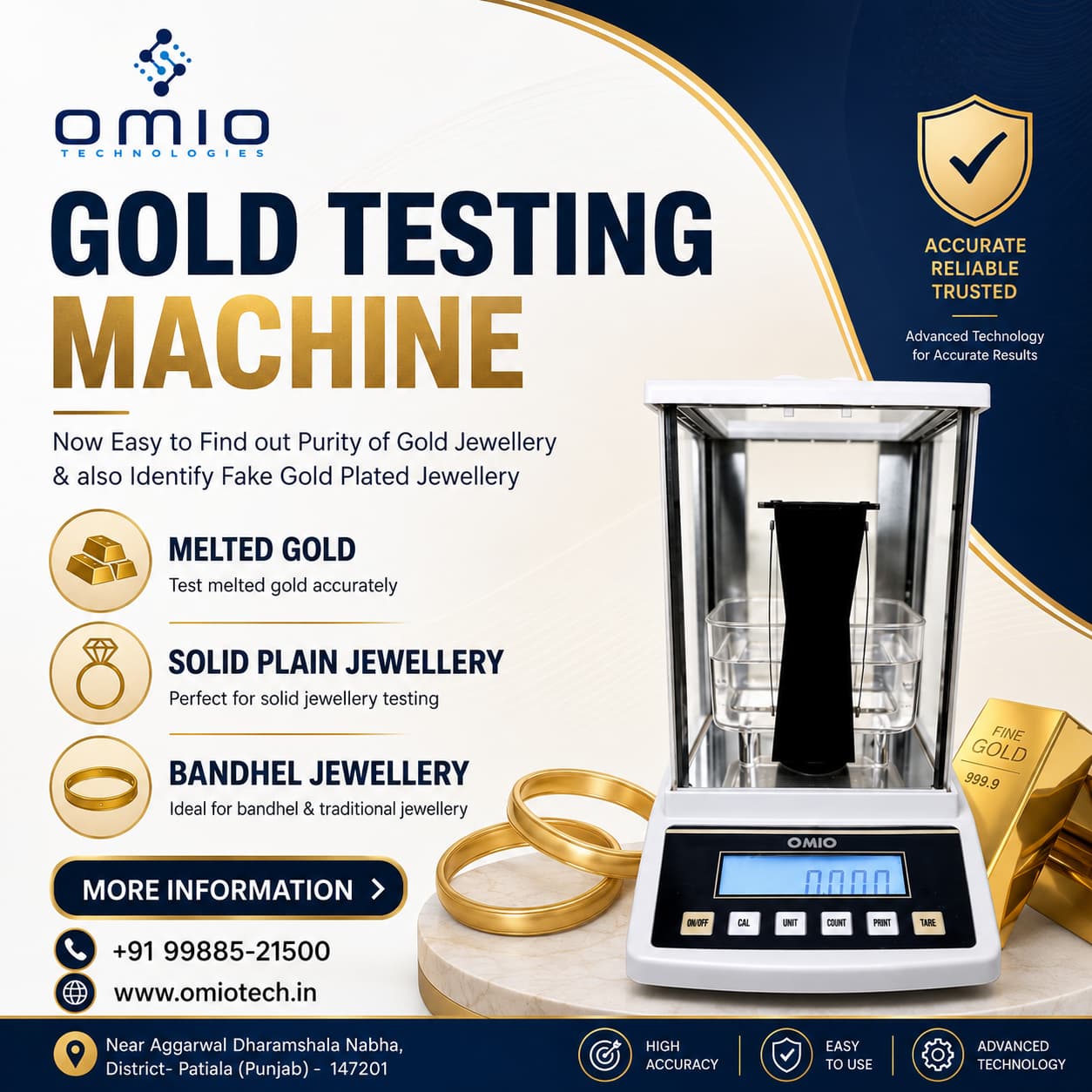
Omio Gold Testing Machine
Omio Technologies manufactures density-technology gold testing machines designed for jewellers, gold buyers, jewellery manufacturers, pawn shops and other businesses involved in gold testing.
The Omio Gold Testing Machine uses density technology based on the Archimedes principle and provides a non-destructive way to assess suitable gold jewellery.
With its focus on simplicity, affordability and practical jewellery testing, density technology can be an excellent choice for businesses that need a reliable routine gold-testing solution.
XRF or Density Meter: Which Should You Buy?
If your primary requirement is elemental analysis and detailed composition, XRF can be the better choice.
If you want a simple, non-destructive, radiation-free and cost-effective method for checking the density and specific gravity of suitable gold jewellery, a density meter can be an excellent option.
The Bottom Line
XRF: Best suited for detailed elemental analysis.
Density Meter: Best suited for practical, non-destructive density-based testing of suitable solid gold items.
For many jewellers, the choice comes down to the type of testing they actually need rather than simply choosing the most expensive technology.
Omio Technologies
Gold Testing Technology for Modern Jewellers.
Explore the Omio Gold Testing Machine and learn more about density-based gold testing for jewellery businesses.
Note: Density testing is not a universal substitute for XRF or laboratory assay. Results depend on the item's construction, alloy composition, temperature and testing conditions.